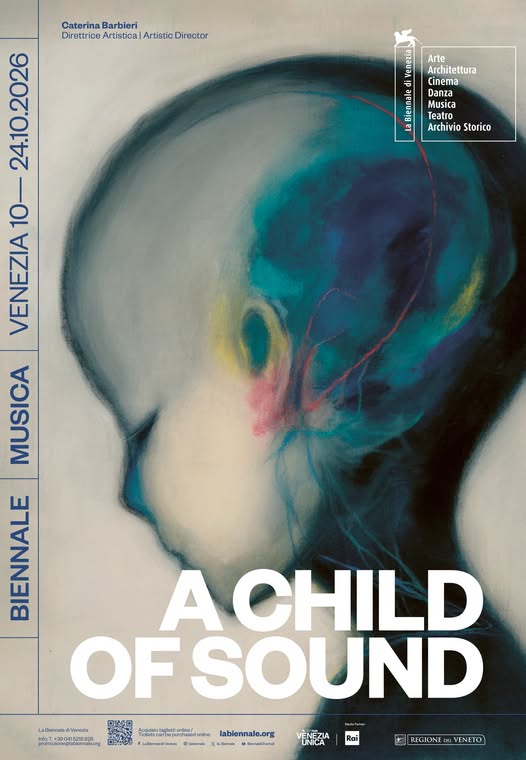
Diamo comunicazione del programma degli eventi della prossima, settantesima edizione della Biennale di Venezia, con la prefazione sul tema A Child Of Sound, fatta della direttrice artistica del festival, Caterina Barbieri.
Music is the childhood of the spirit: an experience that reconnects to a primordial state of openness, vitality and creative power. The grace of the child who looks at the world with the awe of his first gaze, or rather his first listening, with respect for its mystery, is the same grace with which music disarms us.
The aurora of the soul, music precedes the logic of language and strikes us in the most vital, purest and deepest part of feeling. Music also means singing the pain of birth, the loss of fusional unity, to find it again in the ecstasy of sonic unison. For many artists, music has been an instrument of purification and healing since childhood: a natural cathartic process, through which the pain of the world is transformed into beauty thereby protecting the human essence. This is a gift, as well as a duty for the artist: to share and offer the community the therapeutic and redemptive power of music.
A Child of Sound is thus the starting point to build a Biennale Musica that first and foremost restores the deepest value of sound as a collective catharsis.
The composer, philosopher, visionary and mystical Benedictine nun of the High Medieval era, Hildegard von Bingen, describes music as therapy of the soul, a bridge between earth and sky, a “symphony of creatures” in which every living thing participates. In the monasteries she founded, song was an integral part of daily life, understood as a spiritual act that can elevate and connect humans to their original harmony.
A glimpse into the divine, music makes the intangible tangible, becoming a fleeting embodiment of mystery, like a child who lives near the secret of things and respects what cannot be said of them. Like childhood that exists in the here and now, music brings us back to the sacrality of the present, revealing what is eternal about time. “He who has never thought about death is perhaps immortal” declared Carmelo Bene.
A feast of the senses, music enchants bodies and minds, making and unmaking airy cathedrals of feeling: every instant we are reborn in sound, like enamoured dust that vibrates in resonance, touching the interconnectedness of everything that lives.
At a time in which the saturation of reality seems to make us increasingly deaf – not only to pain, but also to joy, ours and that of others – reopening ourselves to listening is imperative today. “A bell was calling back to shore / your sun-drenched joy/ of a child” wrote Antonia Pozzi.
But even reclaiming silence, in the omnipresence of daily clamour, is vital today: silence as the first condition of listening, the seed from which all the melodies of the possible sprout.
The concert is therefore a unique opportunity to stop, to start from silence once again to begin listening and connecting to ourselves and the other, allowing ourselves to be disarmed by music.
That first experience of listening, which is for virgin ears only, is revelatory not only for understanding the music of the present, free from the filter of prejudice or the categories that confine the imagination, but also to start to live again, rather than merely survive, in the contemporary age.
Perhaps this revelation also contains the potential for a revolution, undertaken with the same commitment and devotion with which a child dedicates himself to play, breaking the rules to create new ones, just as the artist necessarily violates the rules of the known to generate innovation.
One of the central figures of the European avantgarde, Karlheinz Stockhausen, frequently linked musical experimentation to the child’s capacity to play with sound, repeatedly asserting that the musician must maintain a mode of listening similar to that of a child: a virgin, non-judgmental listening, free of stylistic expectations or cultural conventions: childhood is thus the original place of radical listening.
Inspired by the child of sound as a symbol of both revolution and healing, La Biennale Musica 2026, titled A Child of Sound, presents an unprecedented programme of world premieres and site-specific works that involve some of the most interesting, innovative and multiform voices in contemporary music, beyond every rigid distinction of genre, era and style, in keeping with the curatorial approach adopted last year.
The programme includes many original commissions and collective works, which explore dynamic and participatory modes of listening.
Qui trovi il programma integrale e dettagliato del festival.