Introduction
By the mid-twentieth century, numerous Western composers, including Pierre Schaeffer, John Cage, and Luciano Berio, had pioneered some of the earliest experiments in electronic music, tape music, and musique concrète. This innovative approach reflected the conditions of the modern era: rapid technological advancement, the pervasive expansion of industrial machinery into human life and the natural environment, and the emergence of weapons of mass destruction. More specifically, it represented an intellectually grounded artistic response to the social upheavals of the time, rejecting anti-cultural tendencies while promoting the celebration of national identity and reaffirming humanitarian values in the aftermath of World War II and at the onset of the Cold War.
Research Background
The dynamic potential for interaction between art, science, and technology underscores the significance of situating Persian soundscapes within contemporary discourse. Expanding the aesthetic spectrum of Iranian art—particularly within the electroacoustic genre—is of considerable importance due to the unique creative possibilities that it offers for exploration. As a medium that establishes interdisciplinary dialogue, the practice nevertheless remains a profoundly neglected field in scholarly research and higher education in Iran. However, in recent years, this area has increasingly attracted substantial attention from leading international researchers who are actively advancing knowledge, fostering innovation, and developing effective methodologies for digital music.
Although computer-based production has undergone remarkable global growth across a wide range of applications—including absolute and programmatic music, film and television scoring, animation, and video games—Iran continues to face shortage of high-quality inventive outputs. The gap can largely be attributed to the absence of an established tradition and the lack of a research-based framework within academic institutions. Consequently, the field demands a more comprehensive investigation to support its future development.
Methodology and Analytical Framework
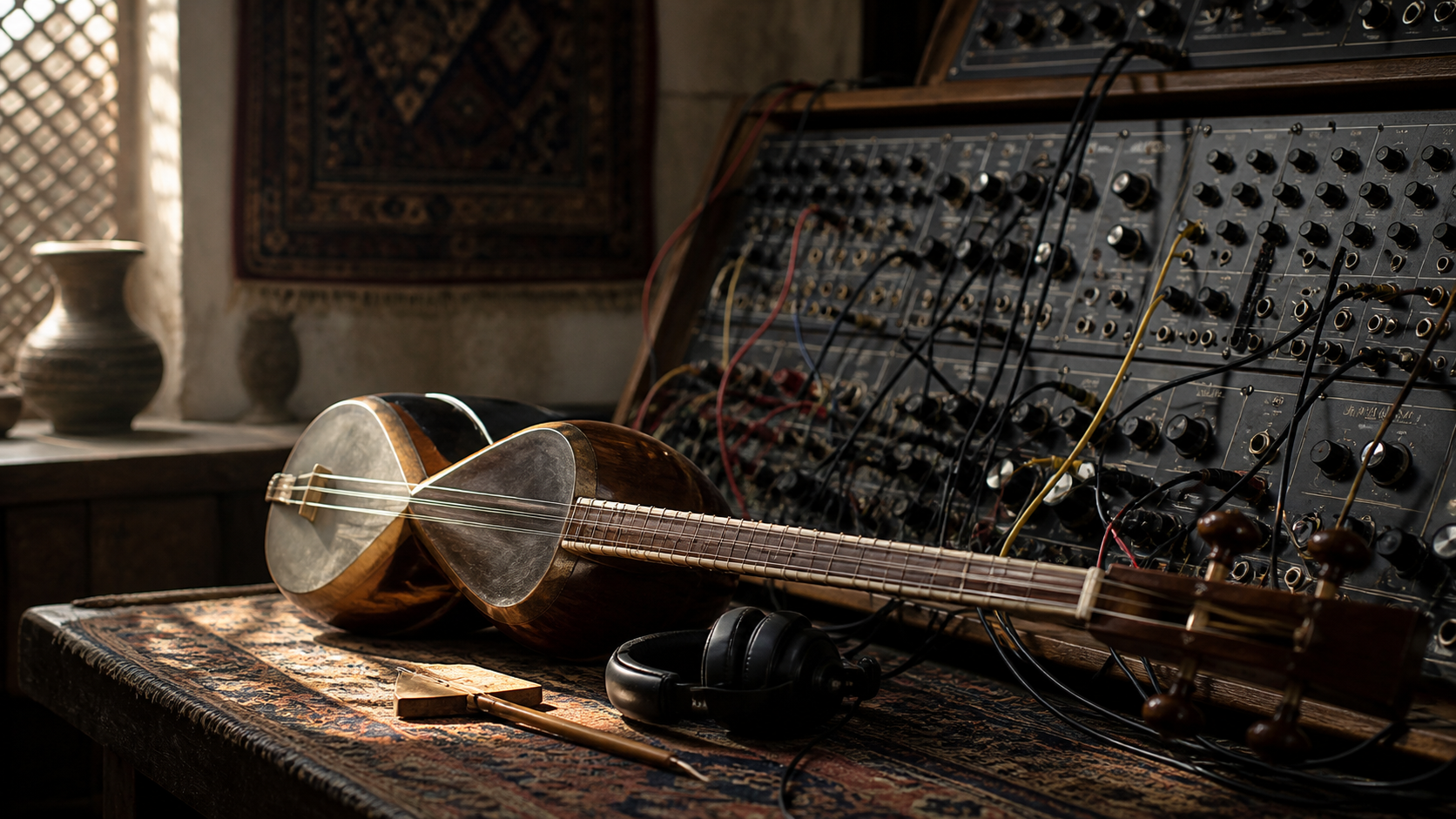
This study aims to articulate and expand the theoretical foundations of electroacoustic music shaped by Iran’s historical heritage. Furthermore, it may support the broader development of sound design by advancing new perspectives. Building upon this objective, the study analyzes tools for the creation of Persian soundscapes within the medium, while formulating new experimental techniques for integrating acousmatic sounds derived from traditional instruments to achieve sophisticated representation and fresh auditory imagery.
It examines models for constructing Persian soundscapes that represent contemporary interpretations of ongoing national events as well as ancient mythological narratives. Emerging concepts provide opportunities for the creation of distinctive territories. These possibilities can offer audiences a more immersive experience, emphasizing the participatory nature of arts. The study also focuses on identifying tools capable of more accurately representing targeted auditory perceptions and sensory experiences, including the evocation of specific nostalgic events, imaginary or real yet dramatized, and particular temporal and spatial dimensions that emerge.
The project further seeks to reimagine Persian soundscapes within the suggested framework by offering sonic structures capable of expressing an authentic yet inclusive shared identity. Another objective is to propose methods for enhancing the application of Persian musical materials, both in the use of acoustic instruments and in the integration of technological resources, with the aim of enriching the repertoire. The study will examine existing challenges and limitations in the creation of such soundscapes and propose strategies for improving the quality of productions.
Scope and Conceptual Direction
While the electroacoustic domain worldwide continues to advance through greater technical development and accessibility to technological resources, only a limited creative works have been identified in Iran. The numerous existing attempts have largely been restricted to the superficial layering of various sounds, without substantial exploration of textural modifications, or a specifically defined Iranian compositional template, despite assertions that they constitute legitimate artistic efforts.
The study will further examine how listeners perceive, interpret, and cognitively organize collective sounds, with particular attention to the temporal organization. Rather than treating time merely as a compositional parameter, the research considers temporality as a fundamental dimension of auditory experience and as a means through which relationships between individual sounds and larger structures are perceived.
To develop this perspective, the study introduces two complementary concepts: temporal directionality, referring to the intrinsic temporal characteristics and trajectories of individual sounds, and temporal spacing, referring to the temporal relationships established through the separation, proximity, and interaction of successive sonic events. These concepts provide an analytical basis for examining how sound structures generate continuity, interruption, anticipation, tension, and perceptual orientation.
Embodied Morphology and Temporality
The research will also investigate the relationship between the internal complexity of sonic layers and their perceptually accessible qualities, considering how timbre, resonance, frequency components, and vibrational properties contribute to auditory and embodied responses. Selected electroacoustic compositions will be comparatively examined to identify compositional strategies that may be adapted to Iranian context. This analysis will contribute to a culturally situated theoretical model for understanding temporal perception and sonic organization within Persian electroacoustic composition.
A variety of cognitive and auditory analytical methods have been proposed for the study of electroacoustic music, many of which focus on identifying the prominent morphological characteristics (i.e., shape, source, etc.) of sounds. However, these approaches often overlook temporality—an essential dimension of music—by treating time primarily as a simple compositional parameter, largely due to its association with traditional musical frameworks such as rhythm and tempo.
The analysis examines the physiological responses elicited by sonic vibrations and the effects of acoustic variation on human perception. It investigates the construction of soundscapes that maintain contextual and representational fidelity to their temporal settings—including diurnal and nocturnal conditions, seasonal variations, and historically or narratively specific periods—and to their spatial contexts, including regional and geographical characteristics.
Particular attention is given to the expressive and affective dimensions of these soundscapes, as well as to the aesthetic frameworks that inform them, within the broader context of authentic Iranian musical traditions. It will empirically investigate how sounds are perceived and processed by listeners, attention given to the relationship between morphology, conscious and unconscious mind, and the responses generated by diverse vibrations, including the inherent frequencies and timbral characteristics produced by acoustic instruments.
Time, Constraints, and the Evolution of Musical Expression
The progression of Western classical music—centered almost exclusively on the cultural perspectives and chronological orientations of Europe, while excluding broader universal viewpoints and thereby implicitly privileging European paradigm—can, like many human activities, be regarded as a prolonged transition toward liberation from the limitations of time, space, accessibility, and the cognitive perception (understanding, appreciation, support, and imitation) of societies. At the center of this lies the evolving concept and inherent quality of “time.” This trajectory has been realized through various means. Such a path has developed throughout centuries and continues in the present-day context through the utilization of digital technologies.
An interesting point is that composers have consistently employed limitations and have considered them as fundamental elements in the formation of their works. This can be traced back to the Middle Ages, when Gregorian chant and other forms of church music developed within established liturgical structures, modal systems, and ecclesiastical rules. These constraints did not merely restrict musical creation; rather, they provided a framework within which composers could shape their ideas.
For example, in Bach’s The Art of Fugue or Vivaldi’s The Four Seasons, music has flourished within an extended temporal framework in which composers established specific aesthetic rules, shaped by an understanding of the achievable possibilities and constraints. This is not surprising: it has long been recognized that, in order to transform sounds into music, given any aesthetics, they must possess a particular structure. In this regard, what method could be more effective than the use of seemingly arbitrary restrictions to reduce the range of choices, ultimately leading to the completion of a piece?
Similar observations regarding the influence of constraints can be applied to the formation of particular instrumental techniques, performance practices, and compositional approaches in post-Islamic Persian music. The influence of Islamic religious teachings is undeniable. Given the distinctive position of music within post-Islamic Iranian society and culture, as well as the various interpretations concerning its legitimacy, the use of musical forms largely developed and gained acceptance within spiritual and educational contexts. Certain forms of this tradition, such as Qur’anic recitation, the call to prayer (adhān), and mystical chants, drawing upon the gusheh structures of the dastgāh/maqām systems, played a primary role in preserving and transmitting its oral elements and theoretical principles.
Since the practice of music-making was predominantly based on solo performance from this period onward, musicians developed techniques such as melodic ornamentation, complex plucking patterns, and subtle instrumental modifications to create sonic variety and encompass a broad spectrum of emotions, while expanding dynamic range and timbral resonance. These characteristics not only emphasized the identity and individuality of the performer but also enabled Persian music to maintain its auditory richness and expressive diversity throughout centuries, even without the use of harmony or polyphony in the Western sense.
As mentioned earlier, these limitations have taken and continue to take various forms. Some are associated with specific musical traditions (for example, religious rituals and ceremonial practices); some are more complex or simpler in nature; and others relate to the materials employed (such as instruments, objects, or techniques) as well as other criteria involved (such as electronic processing, performance venues, and recording methods) that contribute to the transformation of sounds.
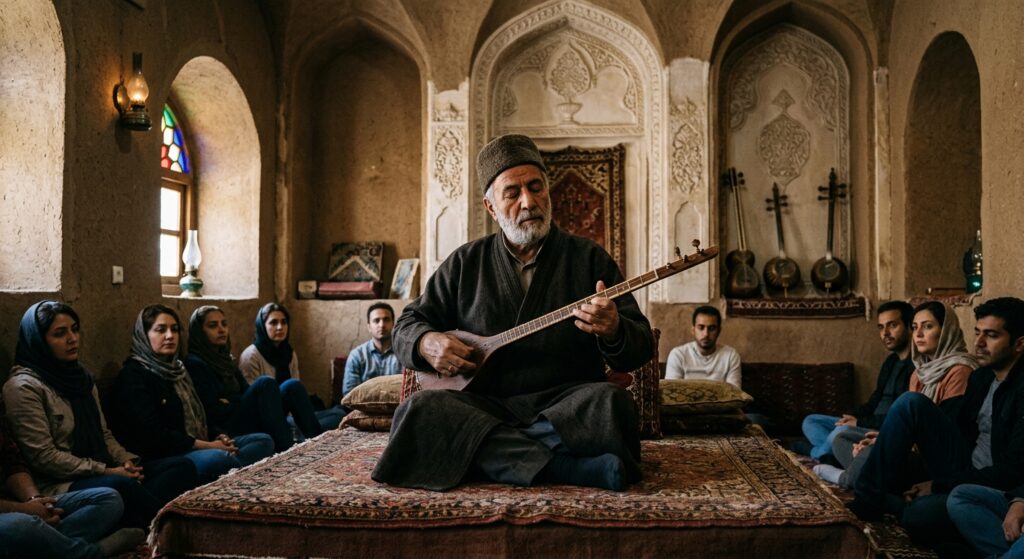
Regarding acoustic spaces, the specific structure of a hall or outdoor settings has a significant impact on the listener’s perception. In post-Islamic Persian music, which has been transmitted primarily through oral tradition and mentor–disciple transmission, this issue becomes particularly relevant. Performance, which was largely based on solo practice, was influenced by prevailing social limitations and ethical beliefs; therefore, it was performed in locations that corresponded to these conditions. For instance, a hall with extensive reverberation and sound reflection would create an entirely different experience from a space in which the acoustics produce little to no reflection.
Resonance, Acoustics, and Continuity
The specific architectural characteristics of a space, which may include low or high ceilings and highly reflective walls or surfaces with minimal reflective properties, can amplify or diminish the sound of solo instruments several times over. In contrast, in traditional Iranian houses, due to their more enclosed structures, sound was often partially muffled; consequently, performance techniques and even the construction of instruments evolved in accordance with these acoustic conditions.
Under such circumstances, subtle sonic features, such as intricate melodic ornamentations, dynamic nuances, and gradual transformations in timbral color, gained greater importance. The doubling or further multiplication of strings, as observed in instruments such as the santur, setar, and tar, similarly served to enhance and extend resonance, helping to sustain and reinforce the reverberant qualities of the sound within these acoustic environments. Furthermore, religious beliefs also influenced the selection of performance spaces. Therefore, these factors not only contributed to the formation of instrumental techniques but also profoundly affected the aesthetic perception and understanding of post-Islamic Iranian music.
In this context, the vocal technique of tahrir, a characteristic form of melodic ornamentation in vocal music, may be understood as another means through which continuity, resonance, and temporal extension are articulated. Produced through rapid, controlled modulation of the voice, tahrir enables a sustained tone to unfold through subtle fluctuations in pitch, timbre, and articulation, thereby prolonging and emphasizing significant melodic tones within the modal structure. Its function extends beyond ornamentation: by allowing a single vocal event to acquire greater duration and internal movement, tahrir can contribute to a perceptual sense of sonic persistence that parallels the effects of reverberation and delay.
When translated into a digital audio environment, analogous spatial and temporal effects can similarly extend the perceived life of individual sounds, whether in enclosed or open acoustic settings, while preserving the expressive characteristics. In this sense, both traditional vocal technique and contemporary sound processing can be understood as strategies for negotiating resonance, spatiality, and continuity in relation to the acoustic character of a given environment.
Mediations of Acoustic Space
With the emergence of technology, particularly the use of loudspeakers in electroacoustic music, the aesthetics and conditions of musical performance underwent fundamental changes. Unlike acoustic music, which had previously been dependent on the architectural structures of spaces and the acoustic features, electronic music could overcome its reliance on traditional acoustic conditions through amplification and reproduction, thereby enabling entirely new forms of sonic experience.
In this way, the selection of a hall or venue is no longer determined primarily by the reflection and reverberation of the space; rather, factors such as the appropriate distribution of loudspeakers, the specific degree of sound absorption or reflection within the environment, precise control over the involved frequency ranges, and even the physical and conceptual design of the space assume greater importance.
On the other hand, the possibility of employing multiple audio channels to project sound from different directions, locations, and designated positions—often dependent on the placement of listeners—has transformed the auditory experience into a spatial and multidimensional experience more than ever before. This development has enabled composers not only to control sonic content but also to exercise precise control over the distribution and movement of sound within space.
Consequently, ideal venues for electroacoustic music performance may differ significantly in their physical and technical structures from traditional concert halls. Some spaces may be designed with minimal reflection in order to achieve complete control over sound, whereas others may incorporate specific resonances as an integral component of their auditory design. These transformations have not only altered our understanding of space and performance possibilities but have also changed the approaches of composers and listeners toward music and the ways in which it is experienced.
The Spatial Reconfiguration of Sound
In electroacoustic performance, the natural reverberation and reflection of a hall are no longer necessarily desirable, because composers have already considered all sonic aspects during the production. Under such conditions, the addition of unintended hall resonance can distort the composition and alter carefully designed details in pieces. For this reason, the ideal venue for such music is a hall that is, as far as possible, free from reflections and, even more preferably, capable of minimizing any unwanted environmental reverberation.
In this regard, spaces equipped with sound-absorbing walls, balanced loudspeaker distribution, and precise acoustic control are considered the most suitable options, as they allow the music to reach listeners exactly as the composer designed it, without unintended alteration or external interference.
Ultimately, all of these limitations and advancements have been developed in response to the fundamental challenge faced by composers: hierarchical organization. Whether in the domains of notation, scales, forms, rhythms, tempo, polyphonic textures, or timbral coloration, nearly all composers have been engaged with the realization of their works and the planning of their structures within complex temporal processes—such that hierarchical organization has often been equated with temporal organization.
Accordingly, within the framework of the theoretical principles of aesthetics involved in creating Persian soundscapes in electroacoustic music, it is necessary to reconsider our approaches toward processing the sounds of Iranian instruments and to develop methods of recreation and reinterpretation. This enables the exploration and utilization of the greater possibilities offered by these instruments with their unique capabilities, whether through innovative performance techniques, traditional methods of execution, or a combination of both.
Through the use of various microphones, each possessing distinctive characteristics and aesthetic qualities in the capture and recording of sound and resonance, we are no longer restricted by live performance spaces and their physical conditions. In this context, unlike acoustic performances, in which the resonance of the space contributes significantly to the aesthetics and sonic identity of the work, electroacoustic music itself determines the nature of its sonic environment.
The limitations of live performances, which previously determined the sonic characteristics of music, have now given way to an approach centered on the use of electroacoustic resources—such as microphones and loudspeakers—for the creation of soundscapes. This enables composers to employ sounds beyond the boundaries of previous concepts of space and time in order to recreate intended histories, their cultural conditions, and the social contexts of the past or present—all while maintaining a distinctive marker of Iranian identity.
Space for Reimagining Cultural Identity
Iranian composers, through the use of electroacoustic music, can experience new possibilities for the recreation and reconsideration of their cultural identity. This genre, which extends beyond the limitations of live performance, provides a space in which sounds can be consciously manipulated, combined, and functionally reinterpreted.
Composers can incorporate elements of traditional music and Iranian instruments within the electroacoustic environment and, through entirely electronic processes, challenge memories, expectations, anticipations, and predictions associated with the characteristic of those sounds, thereby offering new representations of what it means to sound Iranian. This process can introduce identity not as a continuously fixed category, but rather as a fluid phenomenon that is constantly being reconsidered, reorganized, and reshaped, and taking on different forms within each piece.
The second part of this article, scheduled for publication in October, will address further fields of inquiry, examining the various aspects through which electroacoustic music can continually reconfigure any given cultural identity based on regional traditions, oral and written histories, and their evolution.
Bibliography
Couprie, Pierre. “Analytical Approaches to Electroacoustic Music Improvisation.” Organised Sound: An International Journal of Music Technology (Cambridge, UK) 27, no. 2 (2022): 117–30.
Dahan, Kevin. “A Temporal Framework for Electroacoustic Music Exploration.” Organised Sound: An International Journal of Music Technology (Cambridge, UK) 25, no. 2 (2020): 248–58.
During, Jean, Zia Mirabdolbaghi, and Dariush Safvat. The Art of Persian Music. Mage Publishers, 1991.
Howe, Hubert. “Structuring Spectra in Electroacoustic Music.” Organised Sound: An International Journal of Music Technology (Cambridge, UK) 28, no. 3 (2023): 372–80.
Lucas, Ann E. Music of a Thousand Years: A New History of Persian Musical Traditions. 1st ed. University of California Press, 2019.
Miller, Lloyd Clifton. Music and Song in Persia: The Art of Āvāz. 1st ed. Vol. 16. Routledge, 1999.
Rennie, Tullis. “Socio-Sonic: An Ethnographic Methodology for Electroacoustic Composition.” Organised Sound: An International Journal of Music Technology (Cambridge, UK) 19, no. 2 (2014): 117–24.