With the emergence of recording technologies and the electroacoustic revolution in the twentieth century, the production of superhuman sound became a permanent and widely employed feature of the contemporary language. Today, electronic and computational technologies have made it possible for music to unfold over any duration, however short or long; at any sequence, however fast or slow. Music can employ any metrical pattern or combination of patterns, however complex or extensive; encompass any grouping, however dispersed or integrated; and exhibit any degree of repetition, with any desired degree of precision or variation.
These possibilities, which have now become so familiar that they may no longer seem astonishing, have had profound aesthetic consequences. Such effects are evident not only within the electroacoustic medium but also in many instrumental genres, to the extent that it is possible to speak of post-electronic music. Nevertheless, it is noteworthy that the auditory systems receiving these superhuman stimuli, and those inspired by them, remain defined by human limitations. Composers and performers who employ electroacoustic medium may enjoy considerable freedom in their choice of spatial and temporal structures, but they must still decide to what extent these structures should be measured against and coordinated with the limitations of human time.
Perceptual and Contextual Determinants
The relationship between music and experiences of trance and temporality is complex and multifaceted, varying considerably across different musical processes and listening contexts. No single principle can adequately explain these relationships, as the factors shaping them may differ from one instance to another and may even produce contradictory effects. Similarly, the relationship between musical characteristics and listeners’ perceptions of temporal experience cannot be reduced to a universal formula. Rather, it emerges through the interaction of multiple musical parameters and perceptual conditions, suggesting that experiences of time are inherently complex and context-dependent.
Despite the variability of findings across different contexts, several general tendencies suggest that our perception of musical timelessness is associated with the excessive and structure-defying possibilities of temporal organization, in this case afforded through the electroacoustic medium. Extended duration—whether in the form of continuous sonic events or complex musical textures made possible by technologies such as looping or granular synthesis—appears to correlate with an increased sense of timelessness. Resonant pauses and silences also appear to produce this effect. However, the auditory context may be just as important as the relative absence of sound.
The perceived speed of time appears to follow an up–down metaphorical schema, in the sense that increases in certain musical parameters are associated with increases in the perceived speed of time. However, observations do not indicate that this relationship can be reduced to a simple one-to-one correspondence with any particular parameter. Contextual correlations can be observed between the perceived speed of time and factors such as tempo, textural density, sound intensity, and spectral distribution. Other parameters may also be associated with temporal speed in different musical contexts.
Patterns in Temporal Thought
Despite this diversity, these relationships are not arbitrary. Listeners’ reported states and changes in the perceived speed of time exhibit consistent patterns and correspond to objectively identifiable characteristics of the stimuli. Although listeners’ descriptions of the musical features they have heard refer to a range of different parameters, they nevertheless emphasize the importance of excess and the subversion of established structures—both of which constitute the core of my theoretical account of temporality.
The relationship between musical characteristics and subjective experiences of time cannot be explained through a simple causal model. When complex factors such as social expectations, rituals, personal backgrounds, and individual predispositions are taken into account, the range of musical forms that may be associated with altered temporal experiences extends far beyond the limited range considered here.
However, just as it would be overly simplistic to assume a direct causal relationship between musical characteristics and trance states, findings suggest that it would be equally reductive to assume that no definite and demonstrable relationships exist between musical characteristics and subjective experiences of time. This distinction is particularly important when timelessness is understood as a sensation conveyed by the music itself, rather than merely as an effect that music may have on listeners’ mental states, such as trance.
If no relationship existed between musical characteristics and subjective experiences of time—or if these relationships were entirely random—all the examples would be expected to receive similar ratings in terms of the intensity of their temporal qualities. Likewise, the data collected from listeners would be expected to exhibit random distributions, without any meaningful correspondence to the stimuli. However, observations indicate otherwise: clear, consistent, and meaningful patterns can be identified.
Auto-Temporal Organization
As noted above, the excessive and structure-defying transformations of temporal structures, made possible by the production of nonhuman sound, particularly through the electroacoustic medium, are meaningfully associated with the perception of timelessness. Nevertheless, the mapping of these relationships may reveal multiple patterns and interdependencies.
Exploring the multifaceted subject of time in electroacoustic music, the topic is undoubtedly broad, given that music is inherently bound up with time. In Western classical traditions, various temporal dimensions have been notated through a set of conventions, including tempo markings, note durations, meter, and timbral differentiation, the latter articulated through combinations of instrumentation, dynamics, articulation, and ornamentation, although the more nuanced technical details are generally left to the performer. Consequently, discussions of temporality beyond the harmonic and melodic dimensions of tonal music have largely been confined to considerations of meter, rhythm, and, occasionally, large-scale formal structures.
Interest in the subject of time re-emerged in the early twentieth century, spanning fields from physics to philosophy, while experimentation with the temporal organization and duration of music became increasingly widespread, particularly in the works of composers such as Varèse, Cage, and Xenakis, among many others. The growing involvement of electroacoustic composers in this area is hardly surprising, since their liberation from conventional notation placed them directly beyond the constraints of traditional frameworks.
Moreover, explicit reference to clock time became increasingly prominent, whether through the measurement of sounds according to the lengths of recorded tape segments or through the programming of computers in terms of milliseconds and frequencies, thereby establishing a connection between musical practice and scientific measurement. Furthermore, the ability to examine sound structures in detail enabled researchers to analyze sounds, sometimes in the context of timbral investigation and sound synthesis, and to construct new materials that might bear little resemblance to instruments and familiar sound sources.
Conceptualization of Time
For many composers and researchers, therefore, the manifestation and behavior of different temporal dimensions, as well as reflection on the nature of time itself, became compelling subjects for discussion and compositional experimentation. Some of these dimensions can be, and have been, examined within the framework of rhythm. However, the term’s multiple meanings are not always fully acknowledged, and it is not particularly useful for describing the timbral dimension of musical sound. Electroacoustic composers, nevertheless, are well aware that perceptual rhythms can readily be transformed into timbral phenomena, and vice versa, through the overall temporal expansion or compression of sounds.
Despite these developments, discussions of musical time remain fragmented and inconsistent. The various dimensions of temporality are still rarely examined as a coherent set of properties within musicological research, apart from a limited number of contributions by scholars. Unless this body of research becomes more widely systematically examined, and is eventually incorporated into introductory courses in composition analysis, we will continue to lack an established, cross-stylistic vocabulary and conceptual framework for classifying the temporal characteristics of the electroacoustic medium.
Although the term rhythm may seem burdensome in musical analysis, time is even more susceptible to diverse interpretations. This is partly because, while we all recognize time as an integral part of our lives, we lack a simple definition of it and cannot observe it directly. Musicians are perhaps better equipped than many others to understand these difficulties, since sound, too, is invisible, yet we know that it is real and can be studied. We are familiar with spectrograms and amplitude graphs that represent every millisecond of an audio excerpt in precise sequence, and we understand how to move between micro- and macro-levels of analysis. We can therefore recognize how macroscopic components may relate to one another, provided that our focus remains on the linear succession of sounds.
Objective Time vs. Subjective Experience
We know that these measurements correspond precisely to the time displayed by our clocks. Nevertheless, many composers and analysts acknowledge that, despite this precision, a visual representation of a piece in clock time does not necessarily reveal its temporal characteristics fully or accurately as they are perceived. This has led many researchers to reflect on the commonly assumed dichotomy between objective time and subjective or experiential time.
Other perspectives, however, locate the fundamental distinction elsewhere: between cyclical conceptions (the cycle of time) and linear (the arrow of time), or between duration and the succession of events, continuity and discontinuity. Memory, for example, operates on several levels and involves complexities that depend on cognitive processing. In the often abstract world of electroacoustic, listeners can adopt either a close-up or a long-distance view (scale and focus levels) of configurations, potentially producing radically different perceptual outcomes that the composer may not have anticipated.
Electroacoustic offers a distinctive framework for exploring the relationship between sound, memory, and perception through the transformation of acoustic materials. Techniques such as granulation, delay, spectral filtering, and frequency modulation can fragment, extend, and reshape sounds, challenging the stability of their original identity. Through these processes, sound may operate simultaneously as a recognizable expressive gesture and an abstract sonic presence, establishing multiple temporal and spatial layers. The resulting interplay between the immediate and the residual, the audible and the partially obscured, expands the expressive potential of electroacoustic music beyond conventional relationships within purely acoustic settings, and ideas on primary sound, its source, and accompaniment.
Ambiguity and Indeterminacy
The practice also provides a means of translating broader aesthetic and philosophical principles into audible manifestations. The interplay of presence and absence, continuity and fragmentation, and materiality and immateriality can be articulated through the organization of sound, silence, timbre, and spatial depth. Within mixed instruments-electroacoustic contexts, electronic processing can function as an independent expressive layer, responding to the live performers while simultaneously transforming its perceptual implications. Such an approach invites a more active role for the listener, whose interpretation emerges not only from identifiable sonic materials but also from ambiguity, resonance, and the imaginative possibilities opened by what remains acoustically unresolved.
Electroacoustic transformations can destabilize the recognition of sound sources, blur distinctions between foreground and background, and leave sonic relationships unresolved. This ambiguity encourages listeners to participate in constructing meaning rather than simply receiving a fixed musical image. The resulting experience depends partly on what is heard and partly on what the listener imagines beyond the audible material.
Traditional aesthetic principles can inform electroacoustic composition without requiring direct imitation of traditional styles or instruments. Concepts such as restraint, suggestiveness, simplicity, and the expressive potential of silence can be translated into electronic processes through sparse textures, subtle transformations, and carefully controlled sonic density. Technology thus becomes a means of reinterpreting aesthetic principles rather than merely introducing novel sound effects.
Temporal Stratification
In mixed live instruments and electronics, the digital component need not function exclusively as accompaniment or atmospheric decoration. Through independent timbral development, spatial movement, and temporal organization, it can establish an additional expressive layer that interacts with the live materials without duplicating its semantic content. Meaning emerges through the relationship between instrumental articulation, electronic transformation, and the listener’s perception of their interaction.
Live electronic processing introduces a continuous relationship between sound production and sound transformation. The performers’ instruments can generate immediate electronic responses while simultaneously becoming controlled (through varying degrees of notation) or improvisatory material for subsequent processing. This creates multiple temporal layers: the present gesture, its electronically extended continuation, and the residual traces of previous gestures. Musical time becomes perceptually layered rather than strictly linear.
Electroacoustic music can establish a dynamic relationship between audible material and perceived absence. Silence, sparse textures, fading sounds, and incomplete sonic gestures invite listeners to imagine what is not explicitly presented. Absence therefore becomes an active compositional element rather than merely a lack of sound. The interaction between presence and absence can generate ambiguity, openness, and a sense of space that exceeds the immediate acoustic material. Filtering, frequency modulation synthesis, and other techniques allow the spectral characteristics of sound to be reshaped. Such transformations challenge the distinction between acoustic source and electronic result.
A recognizable instrumental source can retain fragments of its original identity while acquiring unfamiliar timbral qualities, creating an intermediate sonic state between the organic and the synthetic. Delay processes introduce temporal distance between an original sound and its subsequent reflections. This separation can transform a single vocal gesture into a layered sonic environment, where the present sound coexists with traces of its past. Electroacoustic space consequently becomes more than a physical dimension; it can function as an audible representation of memory, distance, and the persistence of sonic events beyond their original moment.
Granulation transforms the instrument from a continuous, identifiable sound into microscopic sonic particles. This process creates a shift in perception: the instrument is no longer experienced solely as a carrier of language or melody, but as a malleable sonic material. Through fragmentation, repetition, and redistribution, the original instrument’s identity can become partially obscured, opening a space between recognizable expression and abstraction.
To further explore these ideas, I am presenting two recent compositions that illustrate the topics discussed in the article. The pieces offer an opportunity to encounter these ideas through sound, particularly in relation to the live performance of each instrument—in this case, the piano and saxophone.[1]
Raga Drive
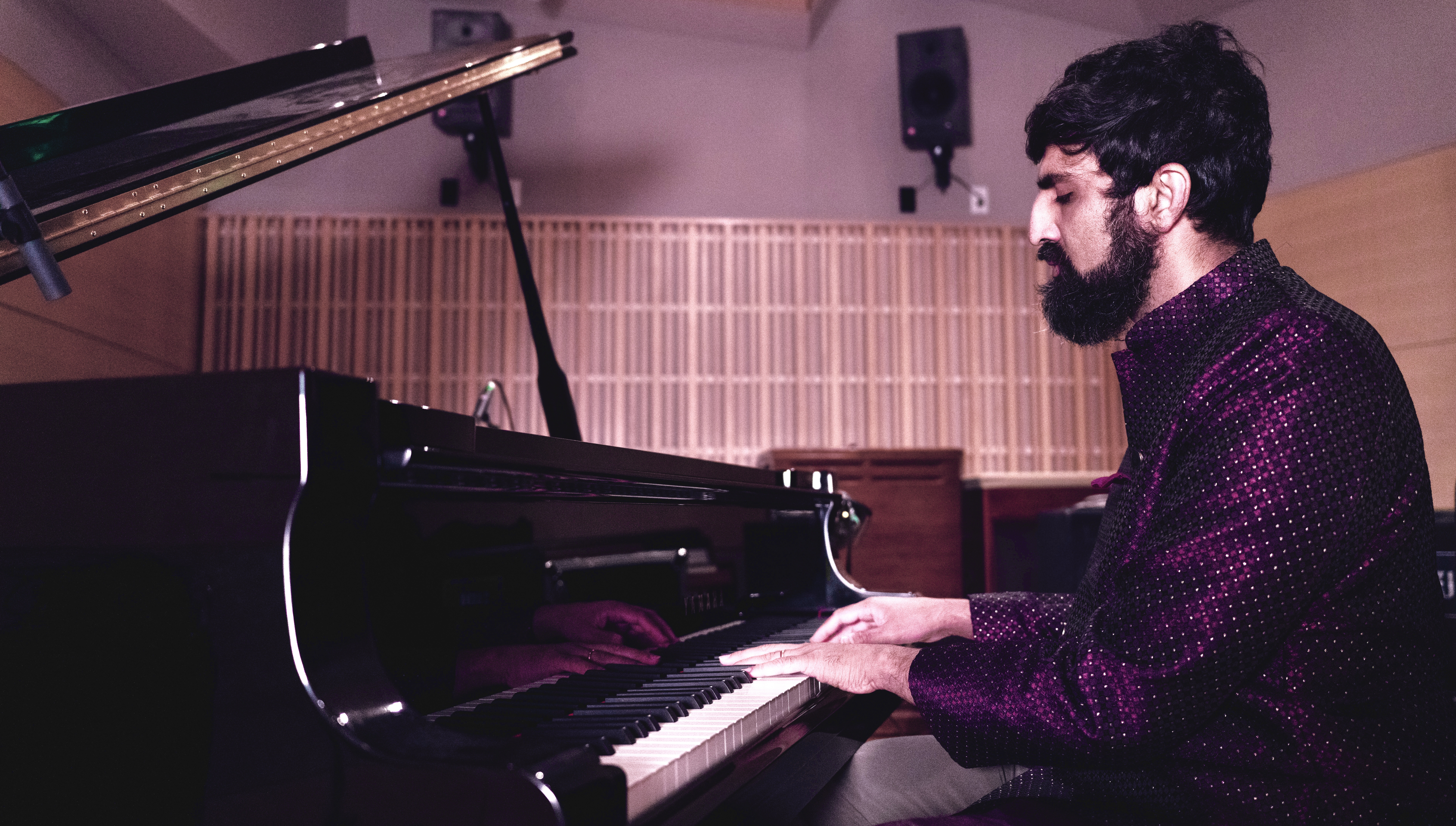
Pianist Nakul Tiruviluamala, Professor of Recording Arts and Technology at Southwestern College, collaborated with me on the first featured composition, Raga Drive. I first developed a series of chordal progressions as a harmonic and rhythmic accompaniment to a foundation of digital sounds. I then invited Nakul to improvise on the piano over the given framework, allowing his performance to interact with the underlying material. Drawing on his background in Western classical and jazz studies, Nakul adapted the piano passages in response to the fixed-media component.
Once I received his professionally recorded studio performances, I reworked my initial musical conception of the piece in response to his interpretation of my earlier electronically generated audio track. I retained primarily the percussive element, particularly the tabla, and reshaped the surrounding soundscape to accommodate the piano, introducing additional highlights at selected moments to emphasize particular aspects of the piano’s rapidly changing character and allowing the interplay between the tabla and the piano to guide the final arrangement.
The soundscape explores the meditative potential of the tabla as a percussive element, drawing on its longstanding role in South Asian traditions. Through rhythmic repetition and subtle variations, the tabla-inspired background establishes a contemplative pulse that complements the piano’s development. Rather than functioning solely as a rhythmic element, the percussion’s distinctive character becomes an integral part of the piece’s identity, shaping its temporal flow across distant worlds of tradition and emerging horizons, while enhancing the interplay between conventional and contemporary expressions. Nakul’s approach draws on his lifelong engagement with Carnatic vocal music, alongside the influence of jazz pianists such as Herbie Hancock, Bill Evans, and McCoy Tyner, particularly their approaches to modal language.
Ancestral Disclosure
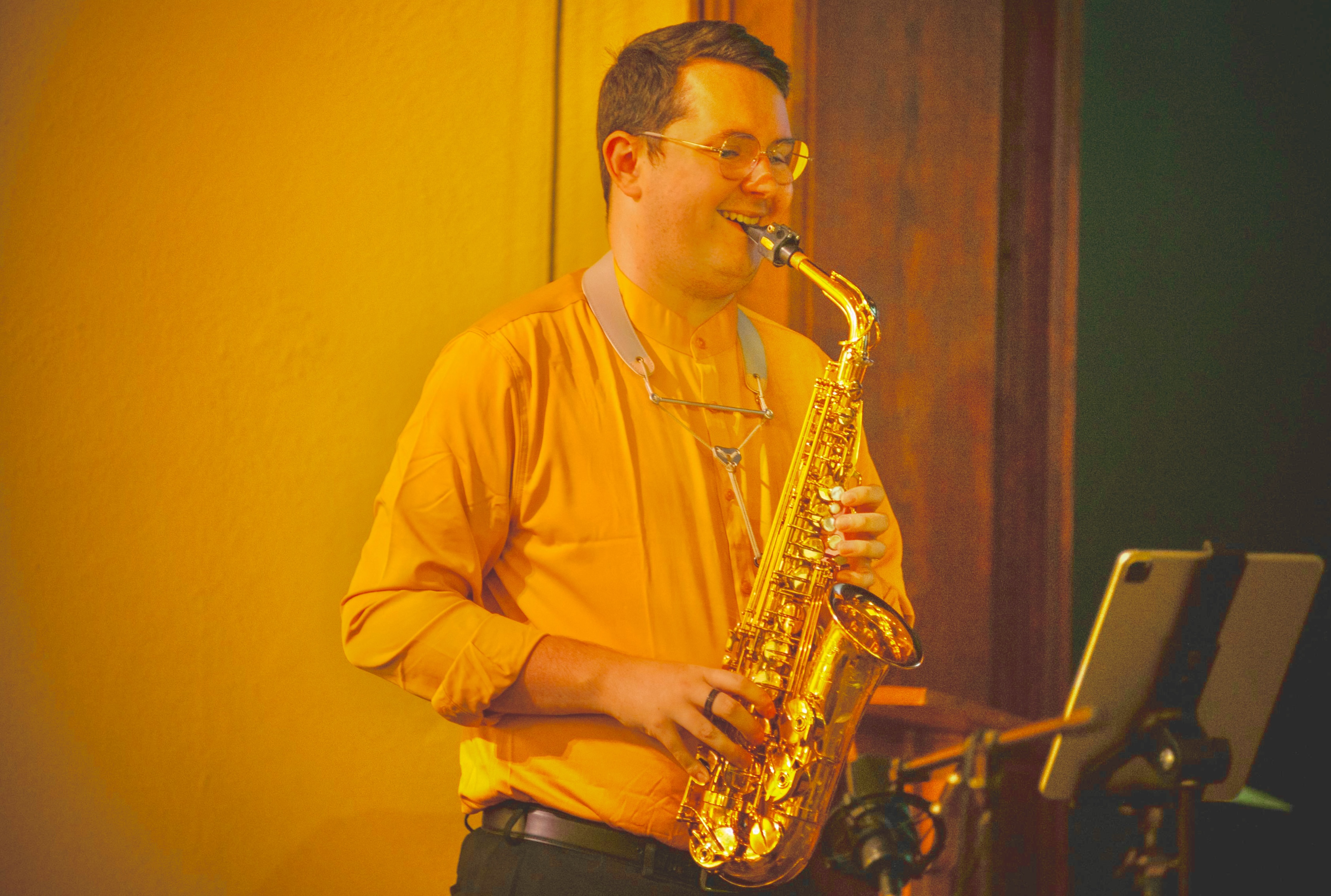
Ancestral Disclosure was composed as a fully notated score for tenor saxophone and fixed media and written for Professor Drew Hosler, saxophone faculty at the Cleveland Institute of Music. Rather than illustrating a specific narrative, the work inhabits the tension between the familiar and the unknown, human presence and greater intelligence. The fixed media creates a rapidly shifting environment of extraordinary power, while the saxophone navigates an increasingly elusive technological space. The score incorporates precisely instructed multiphonics, graphic notation, and textual guidance, allowing the performer a degree of freedom to contribute to the realization of the work.
This flexibility allows for individual interpretation while maintaining the greater composition. The many multiphonics incorporated throughout the piece highlight the instrument’s distinctive metallic qualities while emphasizing the synthetic timbre of the electronics, further elaborating the sonic portrayal. The multiphonic passages invite performers to bring their existing practice into the work while encouraging the continued development of this technique through engagement with the piece. In this sense, the work offers not only an exploration of the saxophone’s extended possibilities but also a practical space for performers to refine their technical vocabulary.
The electronic component functions, in many ways, as a large counterpart to the saxophone, requiring the performer to listen and respond closely in order to align climactic moments. Rather than existing as separate layers, the electronic and acoustic elements support and intensify one another, creating a powerful sound world in which human performance in an acoustic space and digitally produced sound interact as a unified force. More broadly, the work envisions the electroacoustic medium as a dialogue between performers and electronic sound, expanding the imagination of ‘transcendence’ while preserving human agency as central to its identity.
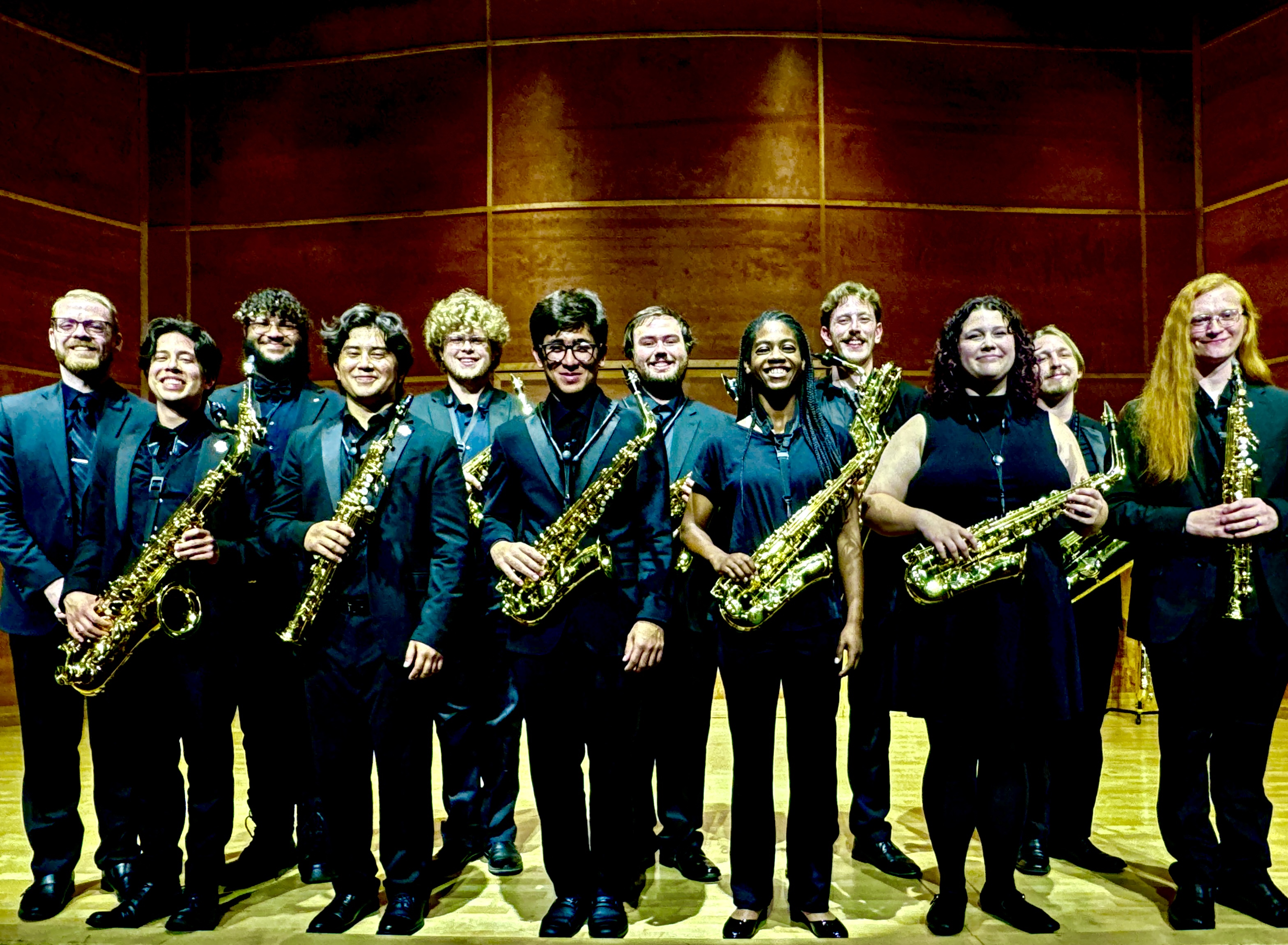
Before I Drown in Tears
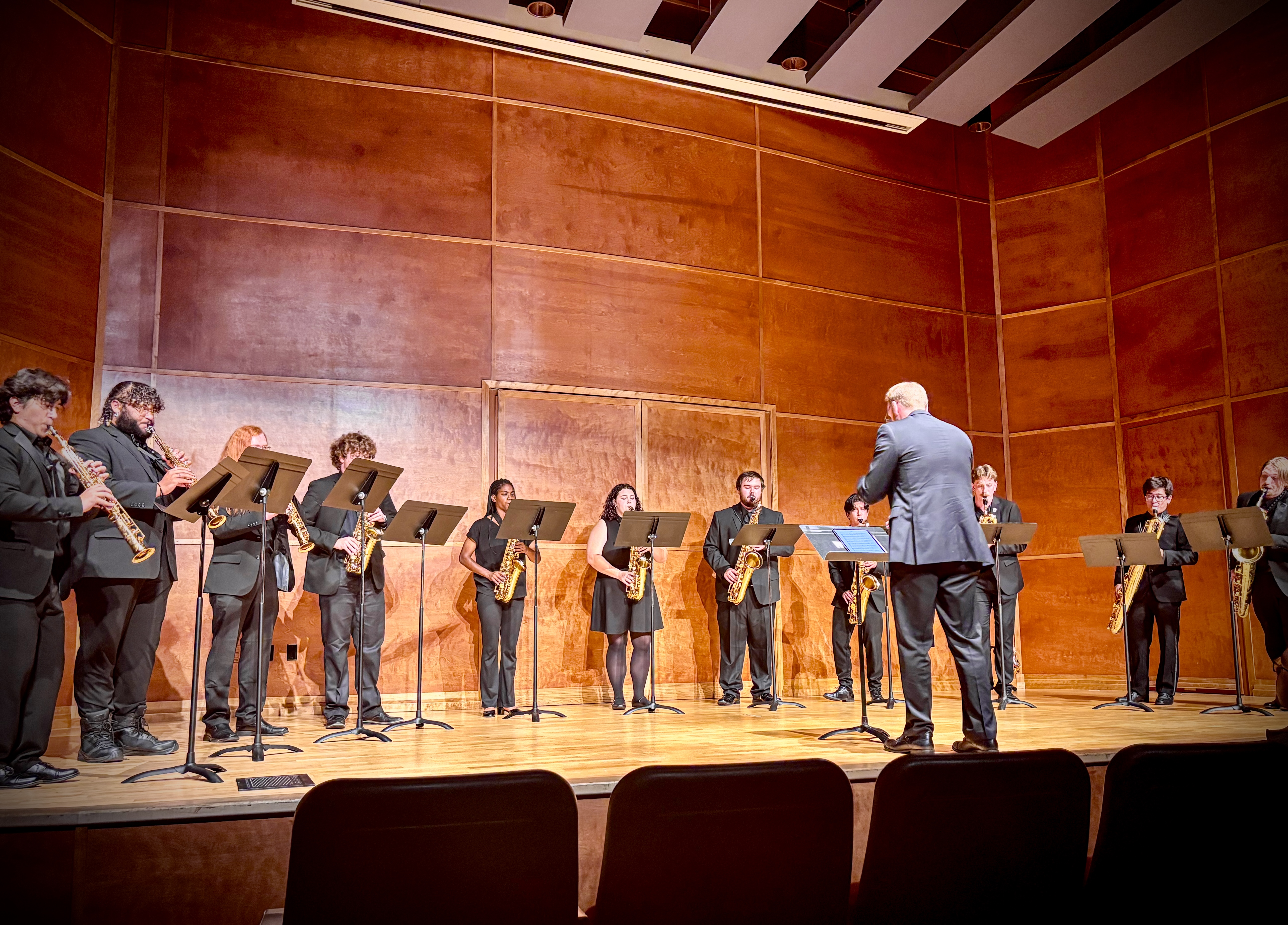
James Barger, Professor of Saxophone at West Texas A&M University, brought a nuanced interpretation to my saxophone ensemble work, Before I Drown in Tears, on 15 October 2026. By adding three instruments to double parts from the original octet, Dr. Barger expanded the ensemble’s depth and textural complexity.[2] Prior to this performance, the work was performed by the Raffles Music College Saxophone Ensemble, under the supervision of Dr. Leslie Wong, at the 15th Singapore Saxophone Symposium on 21 June 2026.[3] Dr. Barger’s arrangement of the piece revealed a fresh perspective that I felt compelled to share alongside this article. I am particularly interested in how the interplay between unison and individual expression among the eleven saxophones shapes the work’s conceptual realization, through the juxtaposition and synthesis of gestures that reflect the metaphor of paint flowing along its own path.
Spatial Structuring and Distribution
The relationship between fixed media and real-time processing offers a flexible framework for organizing sonic continuity, interruption, and spatial presence. Predetermined electronic events can occupy moments of instruments’ silence, while continuous live processing maintains a subtle sonic presence beneath or between foreground events. Such an approach complicates the conventional understanding of silence as an absence of sound, instead treating it as a variable perceptual condition shaped by the density, duration, and spatial distribution of sonic materials.
Through multichannel diffusion, sound can also acquire a spatial dimension that extends beyond its immediate source, creating shifting relationships between proximity and distance, foreground and background, and acoustic presence and absence. These strategies demonstrate how electroacoustic techniques can function not merely as sound-processing tools but as structural and expressive resources that shape musical time, space, and perception.
The integration of electroacoustic sound with live performance further establishes an interpretive relationship between electronic transformation, instrumental timbre, language and style. Variations in production including overall intensity, phrasing, and articulation can interact with electronic textures to create contrasts that extend beyond conventional pitch and rhythmic organization.
Flexible temporal structures allow performers to shape pauses, breathing, and expressive duration according to the concepts offered and interpretive intention, while the electronic layer can reinforce, transform, or complicate the perceptual implications of these gestures. In this context, electroacoustic music becomes an active participant in musical expression rather than a supplementary accompaniment. Its interaction with the performer creates a multidimensional listening experience in which technological mediation, performance practice, and aesthetic interpretation contribute jointly to the communication of meaning.
The fourth part of this article, scheduled for publication in December, will further explore the evolving relationship between electroacoustic techniques, spatial perception, and musical expression.
Bibliography
Couprie, Pierre. “Analytical Approaches to Electroacoustic Music Improvisation.” Organised Sound: An International Journal of Music Technology (Cambridge, UK) 27, no. 2 (2022): 117–30.
Dahan, Kevin. “A Temporal Framework for Electroacoustic Music Exploration.” Organised Sound: An International Journal of Music Technology (Cambridge, UK) 25, no. 2 (2020): 248–58.
Howe, Hubert. “Structuring Spectra in Electroacoustic Music.” Organised Sound: An International Journal of Music Technology (Cambridge, UK) 28, no. 3 (2023): 372–80.
Rennie, Tullis. “Socio-Sonic: An Ethnographic Methodology for Electroacoustic Composition.” Organised Sound: An International Journal of Music Technology (Cambridge, UK) 19, no. 2 (2014): 117–24.
____________________________________
Notes:
[1] All rights to these recordings and associated creative materials belong to their respective creators. The music is provided solely for listening within this journal. No further use, reproduction, or distribution is permitted without prior authorization.
[2] The WT Saxophone Ensemble featured Adrian Perez, EJ Rosette, and Peyton Oden (soprano); Coby Mount, Jordyn Dunlap, and Kelsie Martinez (alto); Nathan Ferris and Jacob Valencia (tenor); and Trace Freeman, Ethan Murray, and Cooper Allen (baritone and bass saxophones).
[3]The ensemble featured Huang RuiYao and Li HengYu (soprano); LuWuYiDi and DuanHeZhiWei (alto); Ma TianRui and Chen HongJia (tenor); and Dang ZiHao and Yin HaoYu (baritone).